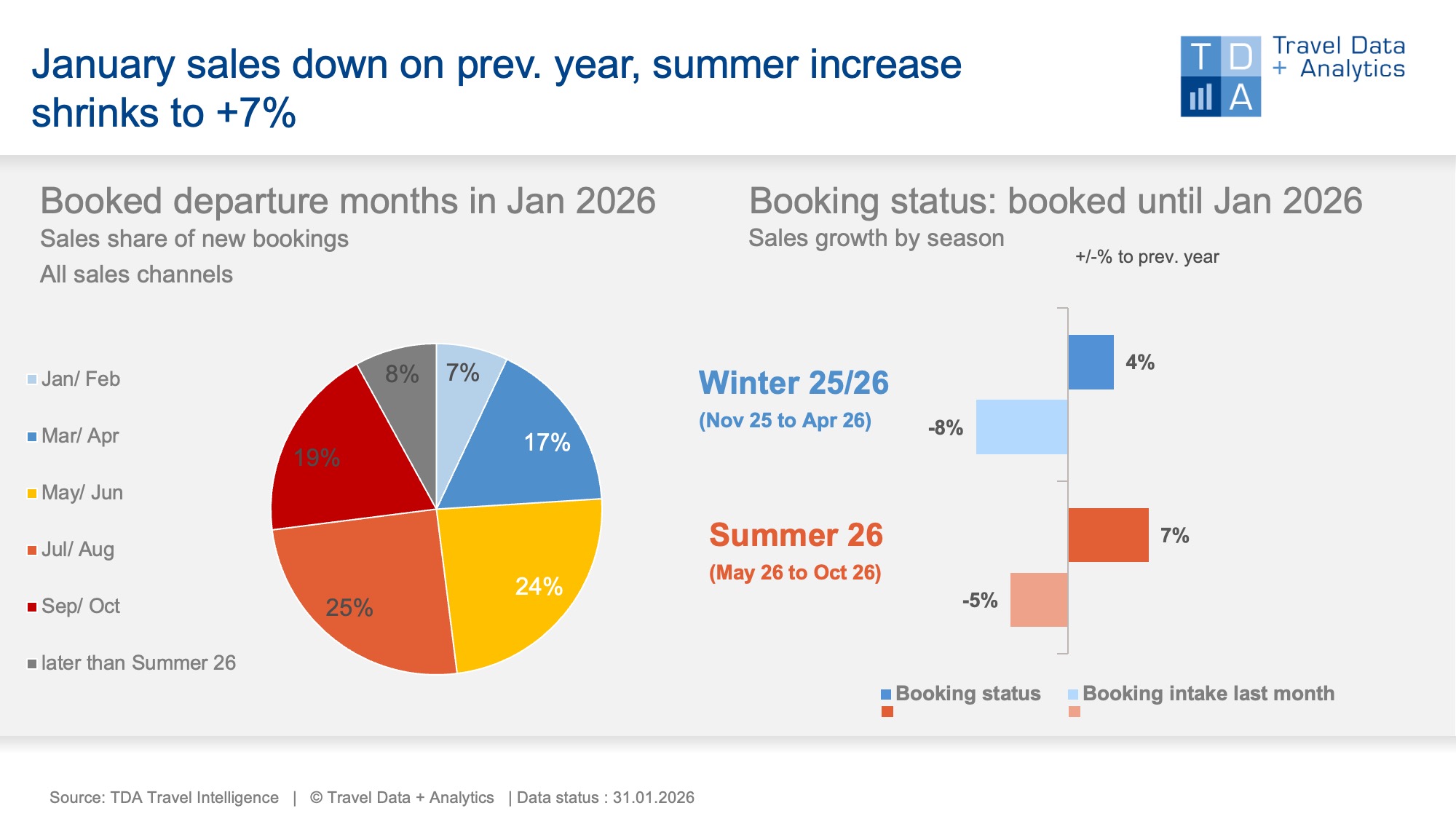
Nuremberg, February 26, 2026 – January is traditionally the strongest booking month of the year in the holiday travel business. This year, however, it was comparatively weaker: booked travel revenues for summer holidays in 2026 were 5 percent below the prior year’s level, and booking intake for winter holidays in the current season was 8 percent lower than in January 2025. The declines should not be interpreted as a sign of reduced travel appetite among Germans. Rather, they result from an unusually strong early-booking segment in the past that had previously boosted growth. With this year’s January correction, the cumulative seasonal balances are shrinking but remain positive: the winter season shows a 4 percent revenue increase, and the upcoming summer season still has 7 percent higher revenues compared with last year.
In January 2026, German consumers spent approximately €3.2 billion on holiday travel booked through agencies or online. Nearly one quarter of this amount was still attributable to the current winter season 2025/26. With negative booking intake year-on-year for January, the cumulative winter season balance dropped to a 4 percent revenue increase, declining two percentage points from the previous month, yet remaining on track for a positive outcome: three booking months before season end, 90 percent of last year’s winter revenues have already been reached (previous month: 79 percent). The number of booked winter travellers as of the end of January 2026 also exceeds the prior year’s season by 2 percent.
Two-thirds of booking revenues in January are focused on upcoming summer holidays. The 5 percent revenue decline in the past booking month is more pronounced due to the larger volume involved: cumulatively, the summer season 2026 has lost about half of its prior growth compared with last month. The current summer revenue balance is now +7 percent, down by seven percentage points compared with the previous period.
Among summer destinations, countries along the eastern Mediterranean corridor stand out with above-average growth. Turkey leads with a 12 percent increase in revenue compared with last year, and Egypt (+18 percent) and Tunisia (+19 percent) also show strong growth on relatively lower revenue bases. In the organised package holiday segment, Turkey is currently the most popular summer destination for Germans in terms of both revenue and booked travellers, closely followed by Spain and Greece. The second major growth driver in the travel market is cruises, with a 10 percent revenue increase compared with the current booking status last year. However, more than half of the expected total summer revenues still remains unbooked if last year’s summer level is used as a benchmark (current fill level: 43 percent; previous month: 30 percent). The outcome of this year’s summer season therefore remains open.
“The traditional January peak in the holiday travel business is losing significance, because an increasingly larger share of holiday volume is booked earlier by advance bookers. As a result, seasonal growth rates are stabilising at a more predictable, single-digit level over time,” explained Alexandra Weigand, Director Sales & Consulting at Travel Data + Analytics (TDA). “The fact that the overall booking decline in January amounts to only -4 percent is itself due to early bookers securing travel for the winter season 2026/27 and even later travel periods in 2027.”
Legend:
The chart illustrates the cumulative travel revenues generated up to the end of January 2026 for the current winter season 2025/26 and the upcoming summer season 2026, each compared with the previous year. TDA’s analysis includes holiday travel bookings made through brick-and-mortar travel agencies as well as online bookings via tour operator websites and Online Travel Agencies (OTAs), with a focus on package holidays. On the left side of the chart, the percentage share of January 2026 booking revenues allocated to the individual travel months or travel seasons is shown.
About TDA Travel Intelligence
Travel Data + Analytics GmbH (TDA) is a data analytics and business intelligence provider for the tourism industry. With Travel Intelligence, TDA operates a data-driven analytics platform for tourism sales. The platform is based on continuously collected booking data from high street travel agencies as well as online sales channels for tour operator products. Data is processed using a modern system architecture that employs advanced analytical techniques and AI-driven methods. The solution supports tourism companies in assessing current booking trends and identifying market potential.
TDA stands for: current market volume + individual market shares + realizable growth potential.
Further information: Alexandra Weigand, alexandra.weigand@traveldataanalytics.de, phone: +49 (0)911 951 510 03