
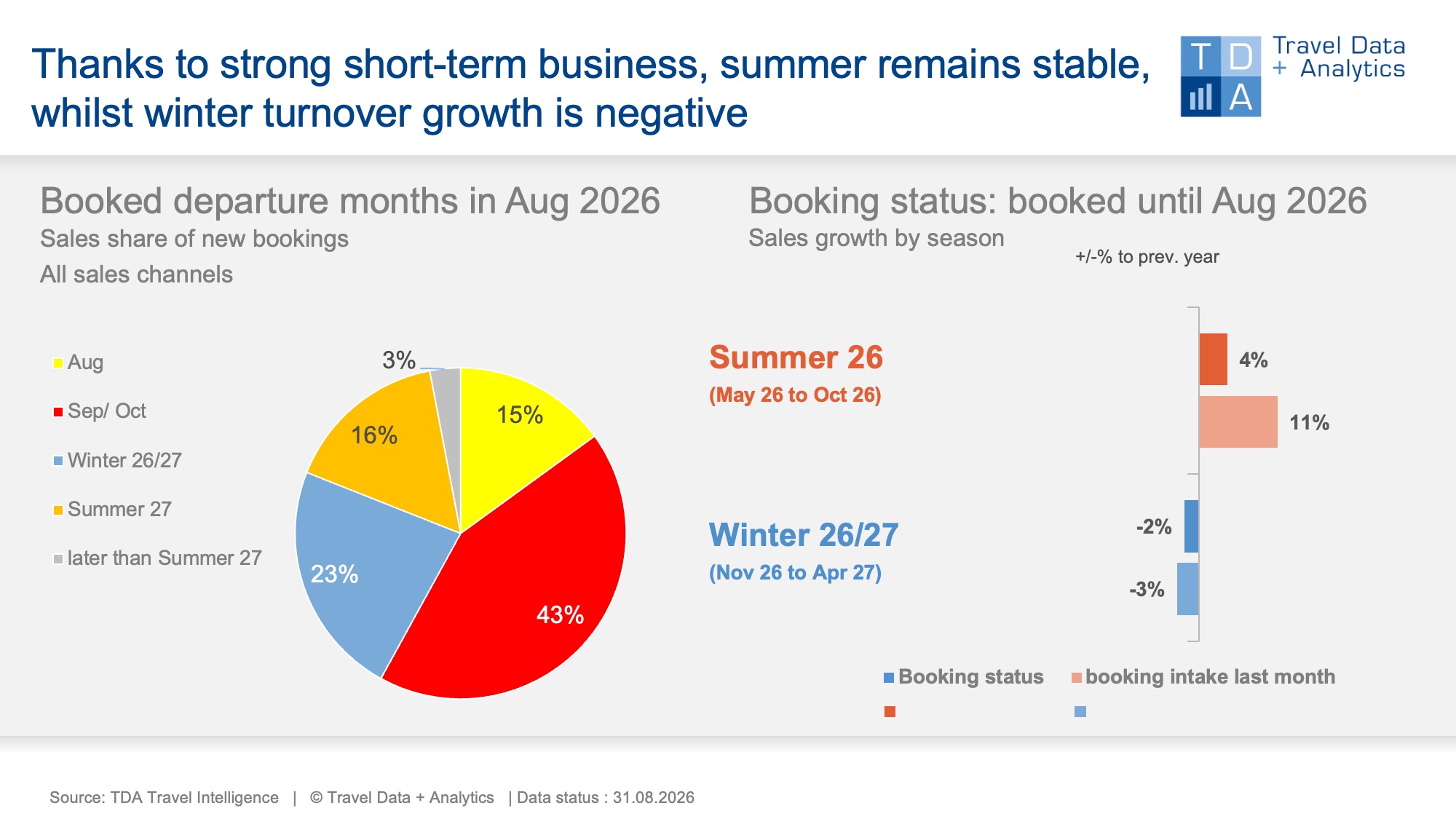
Nuremberg, September 29, 2026 – In August, the volume of short-notice vacation bookings remained strong. For the ongoing summer season, booking revenue is up 11 percent from the previous year. However, this has little impact on the cumulative total: With an improvement in the zero-point range, the figure remains at plus 4 percent for the 2026 summer season, as in the previous month. The upcoming 2026/27 winter season is a cause for some concern: After two booking months of positive growth, new bookings for winter vacations have fallen back below the previous year’s level. Cumulatively, the new winter season is down 2 percent in revenue and 6 percent in the number of booked travelers.
A positive close to the 2026 summer season is now virtually guaranteed. Even if new bookings in the remaining two booking months—September and October—were to remain at last year’s level, the current figures of a 4 percent increase in revenue and a 2 percent rise in the number of booked travelers would still hold. Based on the current booking status as of the end of August, 98 percent of last year’s summer revenue has already been booked. The past booking month was characterized by strong last-minute bookings—accounting for 15 percent of revenue—and a strong focus on fall vacations booked at short notice (43 percent). As a result, more than half of August’s monthly revenue is attributable to the current summer season.
The upcoming 2026/27 winter season is lacking the early bookers who, in past years, had so reliably ensured early growth and a comfortable revenue cushion. Although the negative opening figure for bookings as of the end of May has improved in the meantime from minus 7 percent to the current minus 2 percent, after two months of positive booking growth, figures in August have once again fallen below the previous year’s level (-3 percent). In terms of booked vacationers, the new winter season is currently 6 percent behind last year’s figures. “We’re seeing a certain degree of booking reluctance in the market when it comes to winter vacations. Traditional second vacations with a duration of 8–14 days, in particular, are showing a downward trend, with families affected even more than couples or solo travelers,” explains Roland Gassner, Director of Business Development at Travel Data + Analytics.
In addition, the decline in long-haul travel is weighing on the seasonal results. During the winter travel season, long-haul travel plays a far greater role than in the summer. To date, just under one in four euros spent on vacations has gone toward a long-haul booking. The 10 percent drop in revenue is therefore clearly having an impact. The major long-haul destinations present a mixed picture: for package tours or modular trips organized by tour operators, vacation destinations such as the Maldives, Thailand, and the Dominican Republic are seeing revenue that is slightly above or slightly below their levels from the previous year. Weak demand is particularly pronounced in the United Arab Emirates (-52 percent) and the U.S. (-28 percent). For the U.S., this is already the second winter in a row with waning demand from the German market.
Legend:
The chart shows the travel revenue generated cumulatively by the end of August 2026 for the current 2026 summer season and the coming 2026/27 winter season, each compared with the previous year. TDA's analyses include holiday bookings made both in stationary travel agencies and online via tour operators' travel portals and Online Travel Agencies (OTAs), with a focus on package holidays. The left side of the chart shows the percentage share of revenue in the booking month of August 2026 attributable to the individual travel months and seasons.
About TDA Travel Intelligence
Travel Data + Analytics GmbH (TDA) is a data analytics and business intelligence provider for the tourism industry. With Travel Intelligence, TDA operates a data-driven analytics platform for tourism sales. The platform is based on continuously collected booking data from high street travel agencies as well as online sales channels for tour operator products. Data is processed using a modern system architecture that employs advanced analytical techniques and AI-driven methods. The solution supports tourism companies in assessing current booking trends and identifying market potential.
TDA stands for: current market volume + individual market shares + realizable growth potential.
Further information: Alexandra Weigand, alexandra.weigand@traveldataanalytics.de, phone: +49 (0)911 951 510 03