
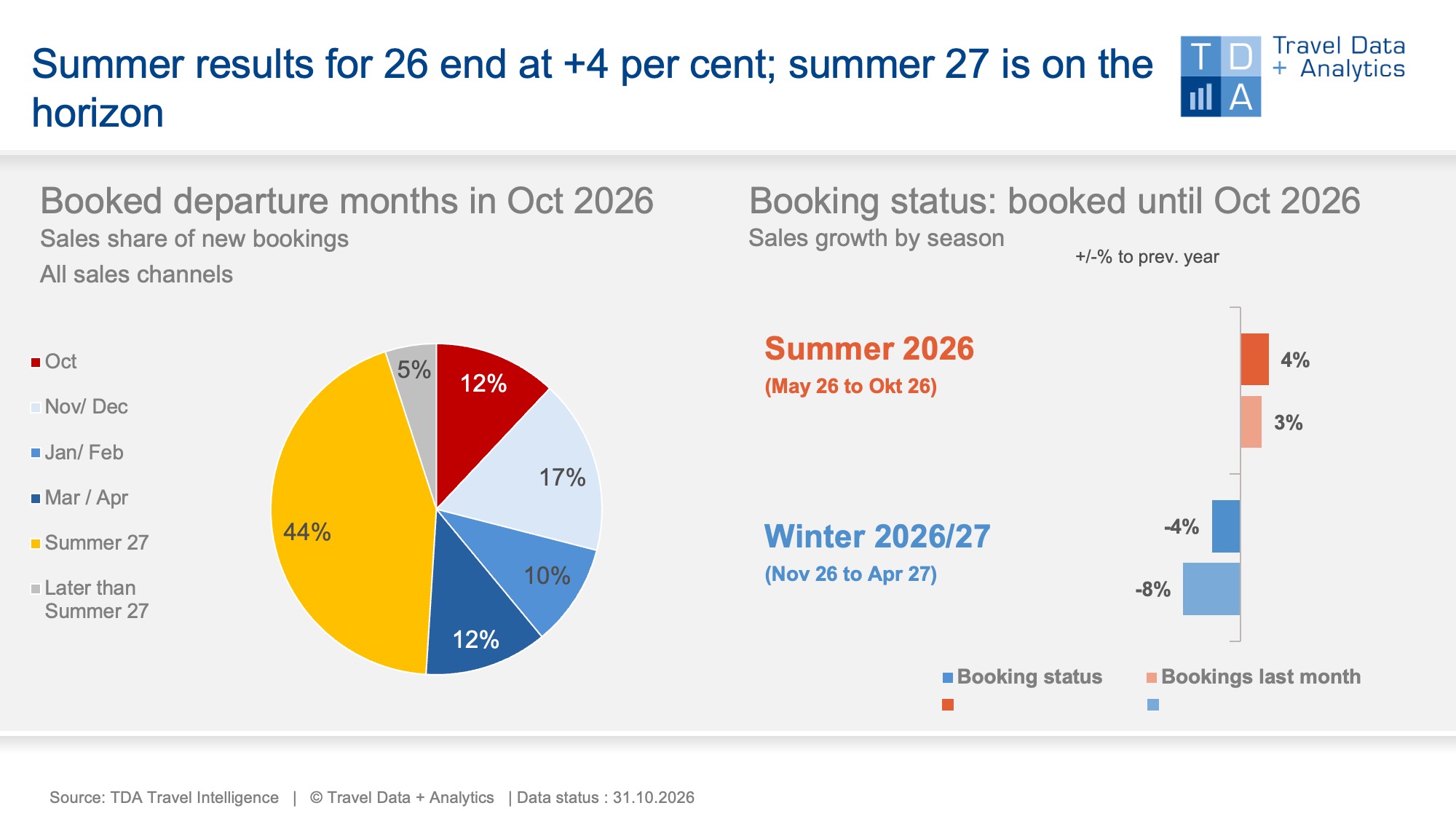
Nuremberg, November 27, 2026 – German citizens spent nearly 17 billion euros on their summer vacations this year, whether booked as package deals or à la carte. As a result, the 2026 summer season ended in late October with a 4 percent increase in revenue compared to the previous year. Demand for the 2026–27 winter season remains comparatively weak: With a decline in new bookings (–8 percent), the winter season has slipped to a cumulative decline of 4 percent—one percentage point more than in the previous month. Instead, vacationers’ interest is increasingly turning toward next year’s summer vacations. In October, the most recent booking month, nearly half of the monthly revenue generated was already attributable to the 2027 summer season and beyond.
The 2026 summer season is now fully booked as of the end of October and has maintained a 4 percent increase in revenue compared to the previous year. In terms of the number of booked vacationers, 2 percent more people traveled on organized package tours than in the previous summer. However, this year’s overall positive summer results are unevenly distributed: Online sales by tour operators and traditional OTAs grew by 16 percent and now account for nearly half of total summer revenue (48 percent). This represents a gain of 5 percentage points compared to the previous year. At travel agencies the 2026 summer season ended with a decline of just over 4 percent. The decline in long-haul travel (-13 percent) is having a disproportionately strong negative impact on their bottom line and cannot be offset by growth in cruise travel (+4 percent). Traditional summer business—beach vacations on the Mediterranean—dominates the travel market and is increasingly being booked online.
Bookings for the new 2026/27 winter season, which kicked off in November, remain subdued. Cumulatively, revenue is currently down 4 percent from the previous year, while the number of booked vacationers is down 7 percent. Compared to total revenue from the previous year’s season, the booking rate as of the end of October stands at 58 percent (previous month: 48 percent). Whether and to what extent this gap can still be closed will depend on last-minute winter and Easter vacationers. However, vacationers’ interest is increasingly shifting toward the summer of 2027: Summer vacations for next year already accounted for 44 percent of revenue in October—the most recent booking month—and rose to 53 percent of new bookings in the first week of November.
Legend:
The chart illustrates cumulative travel sales generated up to the end of October 2026 for the current summer season 2026 and the upcoming winter season 2026/27, each compared with the corresponding period of the previous year. TDA's market analysis covers holiday bookings made through both high street travel agencies and online distribution channels, including tour operators' booking platforms and Online Travel Agencies (OTAs), with a particular focus on package holidays. The left-hand side of the chart shows the percentage share of total sales generated in October 2026 attributable to the individual travel months and seasons.
About TDA Travel Intelligence
Travel Data + Analytics GmbH (TDA) is a data analytics and business intelligence provider for the tourism industry. With Travel Intelligence, TDA operates a data-driven analytics platform for tourism sales. The platform is based on continuously collected booking data from high street travel agencies as well as online sales channels for tour operator products. Data is processed using a modern system architecture that employs advanced analytical techniques and AI-driven methods. The solution supports tourism companies in assessing current booking trends and identifying market potential.
TDA stands for: current market volume + individual market shares + realizable growth potential.
Further information: Alexandra Weigand, alexandra.weigand@traveldataanalytics.de, phone: +49 (0)911 951 510 03